

2027 Bolt EV Home Charging Setup for Oak Lawn Drivers
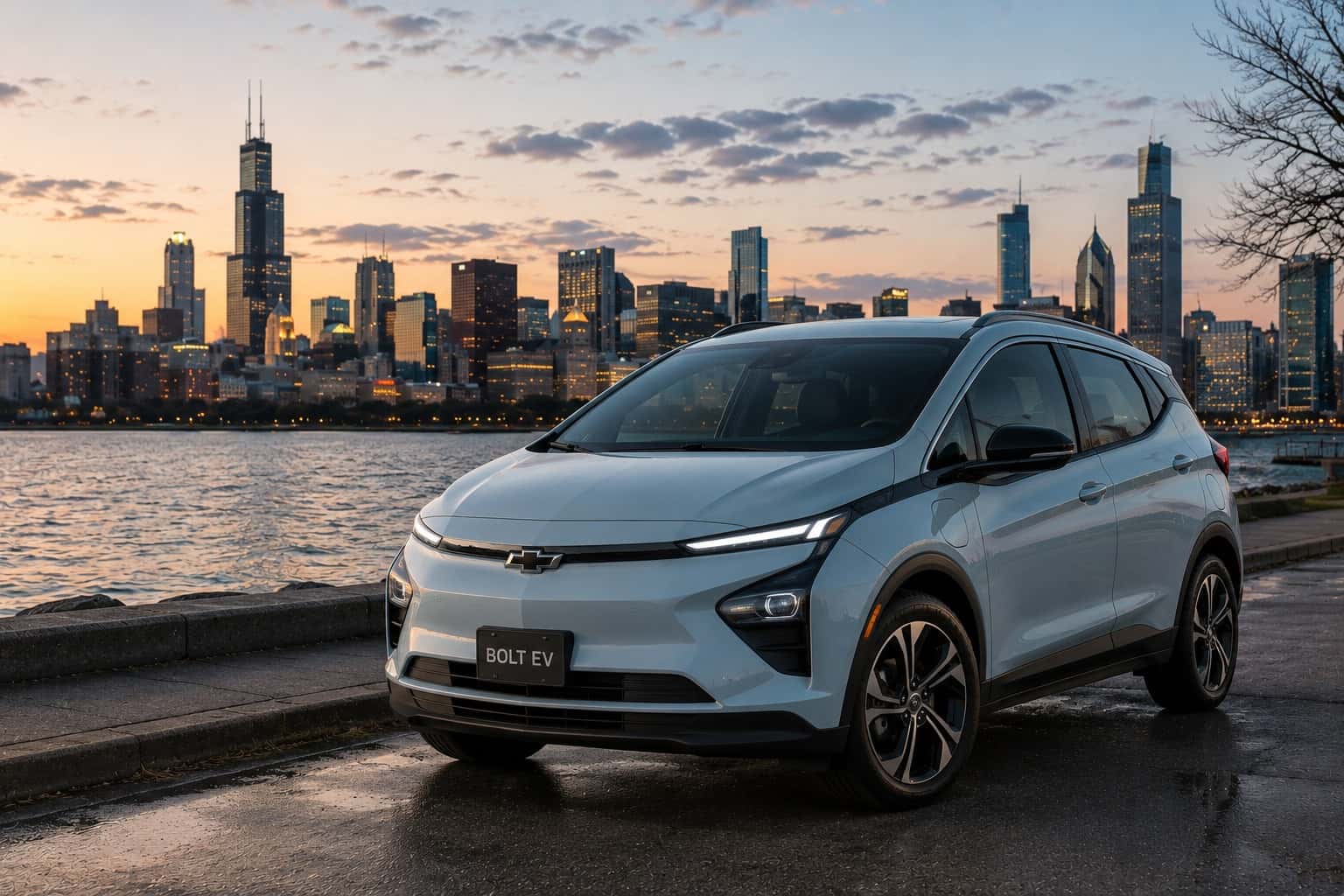
Home Charging Guide
2027 Bolt EV Home Charging Setup for Oak Lawn Drivers
Level 1 vs Level 2, what the typical Oak Lawn home needs, installer recommendations, costs, and bidirectional vehicle-to-home (V2H) considerations. The full home-charging playbook from Webb Chevy Oak Lawn.
Quick Answer
Most 2027 Bolt EV owners in Oak Lawn should install a Level 2 home charger (240V, 30-50 amps). Budget $500-$800 for the charger unit and $300-$1,500 for installation depending on your electrical panel. Level 2 adds 30-35 miles of range per hour, refilling a fully drained battery in roughly 8 hours overnight. Level 1 (standard 120V outlet) works for very light-duty owners but adds only 3-4 miles per hour.
Level 1 vs Level 2: which one fits your driving
Level 1 charging uses a standard 120V household outlet (the same outlet that powers your lamp or phone charger). The 2027 Bolt EV ships with a Level 1 charging cable, so it works the day you take delivery. The catch: it adds only about 3 to 4 miles of range per hour. From a fully drained battery, that’s roughly 70 hours to fill. Practical translation: Level 1 works if your daily commute is under 25 miles and you can leave the car plugged in for 8-plus hours overnight every night without exception.
Level 2 charging uses a 240V circuit (the same voltage as your electric dryer or oven). It adds 30 to 35 miles of range per hour, refilling a fully drained battery in roughly 8 hours. For 95 percent of Bolt EV owners, Level 2 is the right answer. Plug in when you get home, wake up to a full battery, drive 200+ miles with margin to spare the next day.
| Setup | Adds | Full Charge | Cost to Install |
|---|---|---|---|
| Level 1 (120V outlet) | 3-4 mi/hr | ~70 hrs | $0 (cable incl.) |
| Level 2 (240V) | 30-35 mi/hr | ~8 hrs | $800-$2,300 |
What the typical Oak Lawn home needs for Level 2
A Level 2 home charger needs three things: a dedicated 240V circuit, the charger unit itself, and an installation by a licensed electrician.
- Available electrical panel capacity. Most older Oak Lawn homes (especially pre-1980 construction) have 100-amp service panels that may be tight on capacity. Newer homes typically have 200-amp service which has plenty of room. An electrician can run a load calculation to confirm.
- A dedicated 240V circuit. The electrician will install a new circuit breaker, typically 40 amps for a 32A continuous charger or 50 amps for a 40A continuous charger. The wire runs from your panel to the charger location, usually in the garage.
- The Level 2 charger unit. Popular options for Oak Lawn-area buyers include the ChargePoint Home Flex, the Wallbox Pulsar Plus, the Grizzl-E Smart, and the Tesla Wall Connector (which works with the Bolt’s NACS port). Budget $500 to $800 for the unit.
Installation cost: what affects the bottom line
Installation cost varies dramatically based on three factors: distance from your electrical panel to the charger location, whether your panel has open capacity, and whether your house wiring needs upgrades.
| Scenario | Typical Cost |
|---|---|
| Panel in garage, 200-amp service, simple install | $300-$600 |
| Panel in basement, garage detached, modest wiring | $700-$1,200 |
| Older home, panel upgrade required | $1,500-$3,500 |
| Charger on detached garage, long wire run | $1,200-$2,500 |
Always get at least two quotes from licensed Illinois electricians before scheduling installation. Ask if they’re EV-charger experienced. Pull permits matter. The City of Oak Lawn and most south suburbs require electrical permits for new 240V circuits, so a permit-pulling electrician protects your home insurance and resale value.
Vehicle-to-Home (V2H) bidirectional charging
The 2027 Bolt EV supports bidirectional V2H charging, which means in the right setup, the battery can power your home during an outage. This is a feature most affordable EVs at this price point don’t offer, and it’s a meaningful Chicago-area advantage given winter ice storms and summer thunderstorm-driven power outages.
V2H is not plug-and-play. You need: a compatible bidirectional Level 2 charger (currently more expensive than standard L2 chargers, $2,000+ for the unit), a home transfer switch installed by a licensed electrician, and proper utility interconnection paperwork through ComEd. Total V2H setup runs roughly $4,000 to $8,000 above the base charger cost.
For most Oak Lawn buyers, V2H is a year-2 or year-3 upgrade rather than a day-one install. Start with a standard L2 setup. If you find yourself wishing for backup power during outages, upgrade to V2H later.
From Our Oak Lawn EV Specialist
Get the electrician quote BEFORE you finalize your Bolt EV order. We’ve seen Cicero Avenue customers buy their EV first, then find out their 1960s-era Oak Lawn home needs a $3,000 panel upgrade before Level 2 will work. That doesn’t kill the deal, but it changes the total budget picture. A 30-minute home visit by an electrician costs $100-$150 and gives you the real number before you commit.
ComEd EV rates and time-of-use billing
ComEd (the electric utility for Oak Lawn and most of the south suburbs) offers special EV-friendly rate plans that significantly reduce overnight charging costs. The current EV rate program charges meaningfully less per kWh during off-peak hours (typically 10 PM to 6 AM) than during daytime peak hours.
Most home chargers, including the ChargePoint Home Flex and Wallbox Pulsar Plus, let you schedule charging to start automatically at off-peak hours. Set it once, plug in every night, save money automatically. Over a year of typical charging, the EV rate plan can save $200 to $400 vs the standard residential rate.
Visit comed.com or call ComEd to enroll in the EV rate program before your first electric bill arrives.
Charger features worth paying for
- Wi-Fi connectivity and an app. Lets you schedule charging, track usage, set off-peak start times.
- Smart amperage adjustment. Lets the charger throttle automatically based on what your panel can handle. Useful in older Oak Lawn homes with tight panels.
- Cable management. A retractable holster or wall-mount hook keeps the cable off the floor when not in use.
- 30-amp minimum continuous rating. Some bargain chargers only support 16A continuous. Skip those. 30A continuous is the floor.
- UL certification. Required for safety. Avoid any charger without UL listing.
Frequently asked questions
Can I install a Level 2 charger myself?
Not recommended. Installing a new 240V circuit involves your main electrical panel, which is a permit-required job in Oak Lawn and most surrounding suburbs. Hire a licensed Illinois electrician. Improper installation creates fire risk and can void your home insurance.
Do I need a NACS connector on my home charger?
No. The 2027 Bolt EV ships with a J1772-to-NACS adapter, so any standard J1772 Level 2 charger (the connector type used by ChargePoint, Wallbox, Grizzl-E, etc.) works fine. You only need a native NACS charger if you specifically want a Tesla Wall Connector, which is also a strong option.
What if I rent or live in an apartment?
EV ownership without home charging is possible but harder. Look for workplace charging or accessible Level 2 public charging within a few miles. Some Oak Lawn apartment buildings are adding shared chargers. Talk to our EV specialist before you commit to a Bolt EV purchase if your charging situation is uncertain.
Are there tax incentives for home chargers?
The federal Alternative Fuel Vehicle Refueling Property Credit may cover up to 30 percent of home EV charger installation cost (up to $1,000), subject to eligibility. Check current IRS guidance. Some Illinois utility rebate programs come and go. ComEd offers occasional charger rebates. Our finance team can flag what’s currently available.
How much will charging cost on my electric bill?
At ComEd’s current EV rate program, full-charging a fully-drained 65 kWh battery overnight costs roughly $4 to $7 depending on time of year. That’s 255 miles of driving for $4-$7, equivalent to roughly 40-65 cents per gallon if it were a gas car.
Need help planning your home charging setup?

0 comment(s) so far on 2027 Bolt EV Home Charging Setup for Oak Lawn Drivers